Sitemap
A list of all the posts and pages found on the site. For you robots out there, there is an XML version available for digesting as well.
Pages
Posts
Future Blog Post
Published:
This post will show up by default. To disable scheduling of future posts, edit config.yml and set future: false.
Blog Post number 4
Published:
This is a sample blog post. Lorem ipsum I can’t remember the rest of lorem ipsum and don’t have an internet connection right now. Testing testing testing this blog post. Blog posts are cool.
Blog Post number 3
Published:
This is a sample blog post. Lorem ipsum I can’t remember the rest of lorem ipsum and don’t have an internet connection right now. Testing testing testing this blog post. Blog posts are cool.
Blog Post number 2
Published:
This is a sample blog post. Lorem ipsum I can’t remember the rest of lorem ipsum and don’t have an internet connection right now. Testing testing testing this blog post. Blog posts are cool.
Blog Post number 1
Published:
This is a sample blog post. Lorem ipsum I can’t remember the rest of lorem ipsum and don’t have an internet connection right now. Testing testing testing this blog post. Blog posts are cool.
news
Start of AI for Program Reasoning Programme
Published:
The AI for Program Reasoning project has officially started. Please check the following news:
projects
publications
Agentic Concolic Execution
Published in IEEE Symposium on Security and Privacy, 2026
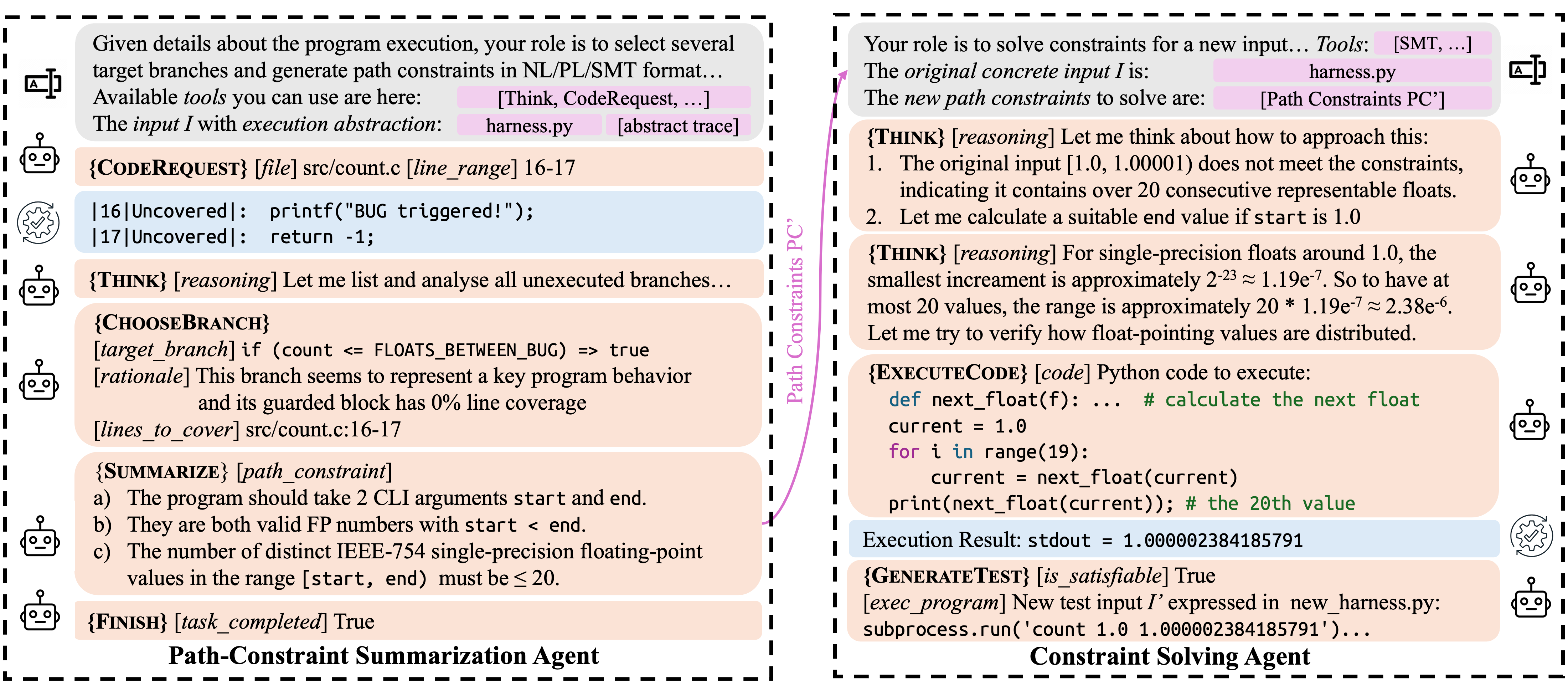
Concolic execution is a practical test generation technique that explores execution paths by coupling concrete execution with symbolic reasoning. It runs programs on given inputs while capturing symbolic path representations, then mutates and solves these constraints to generate new test inputs for alternative paths. This approach has several fundamental challenges, such as (C1) the inherent complexity of symbolically modeling diverse programming language constructs and environmental interactions, and (C2) the scalability issues of constraint solvers when handling large, complex formulas. In this work, we investigate whether LLM agents can help address these longstanding challenges in test generation. We propose a novel workflow which we call agentic concolic execution. Using an LLM agent for symbolization, our approach is language-agnostic and can handle environmental constraints without additional manual modeling effort. To ease pressure on the constraint solver, we allow an LLM agent to summarize and even reason about constraints directly in natural language. In a significant evaluation of 12 real-world subjects, our research prototype ConcoLLMic attains significantly higher code coverage (115%-233% higher) than state-of-the-art symbolic executors like KLEE that have been painstakingly hand-crafted over many years, and identifies 11 new vulnerabilities. Our results show that multi-step planning and tool integration enable agents to effectively mitigate reliability issues inherent in LLM-based analysis and even reason symbolically about code.
Agentic Verification of Software Systems
Published in ACM International Conference on Foundations of Software Engineering, 2026
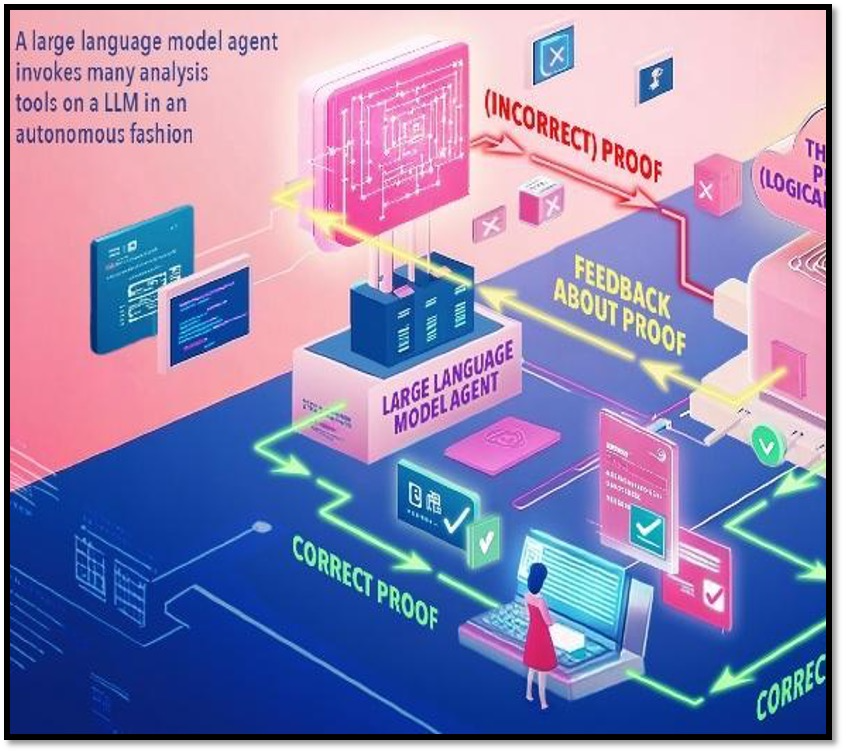
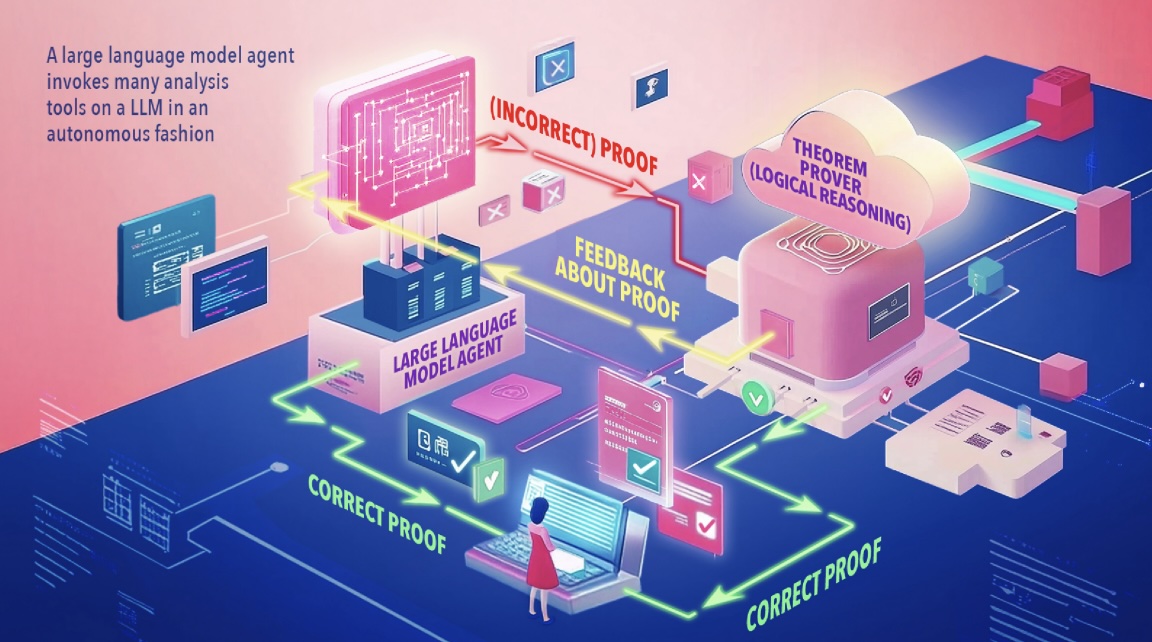
Automatically generated code is gaining traction recently, owing to the prevalence of Large Language Models (LLMs). Further, the AlphaProof initiative has demonstrated the possibility of using AI for general mathematical reasoning. Reasoning about computer programs (software) can be accomplished via general mathematical reasoning; however, it tends to be more structured and richer in contexts. This forms an attractive proposition, since then AI agents can be used to reason about voluminous code that gets generated by AI. In this work, we present a first LLM agent, AutoRocq, for conducting program verification. Unlike past works, which rely on extensive training of LLMs on proof examples, our agent learns on-the-fly and improves the proof via an iterative refinement loop. The iterative improvement of the proof is achieved by the proof agent communicating with the Rocq (formerly Coq) theorem prover to get additional context and feedback. The final result of the iteration is a proof derivation checked by the Rocq theorem prover. In this way, our proof construction involves autonomous collaboration between the proof agent and the theorem prover. This autonomy facilitates the search for proofs and decision-making in deciding on the structure of the proof tree. Experimental evaluation on SV-COMP benchmarks and on Linux kernel modules shows promising efficacy in achieving automated program verification. As automation in code generation becomes more widespread, we posit that our proof agent can be potentially integrated with AI coding agents to achieve a generate and validate loop, thus moving closer to the vision of trusted automatic programming.
Automated Lemma Discovery in Agentic Program Verification
Published in IEEE/ACM International Conference on Automated Software Engineering (ASE 2026), 2026
Deductive verification provides strong correctness guarantees by generating verification conditions (VCs) from a program and its specification and proving them formally. Proving these VCs is the expertise-intensive bottleneck, and LLM-based proof agents have recently begun to automate part of it. However, existing proof agents cannot discover auxiliary lemmas, so they struggle as programs grow larger and more complex. We argue that proving VCs relies not only on mathematical reasoning but also on understanding the program: human proof engineers draw on program semantics that the output of VC generators does not make visible. Based on this insight, we present LemmaNet, an agent that discovers lemmas in two ways. Offline, it analyzes the source code and specifications to write lemmas and connects them to the verbose VC encoding. Online, it revises existing lemmas as the proof state evolves. LemmaNet is built on the AutoRocq proof agent for Rocq and the Frama-C ecosystem. We evaluate LemmaNet on SV-COMP and on real-world subjects including Linux kernel modules, Contiki OS, the C++ standard library, and an X.509 parser, where it significantly outperforms state-of-the-art approaches.
Finding Memory Leaks in C/C++ Programs via Neuro-Symbolic Augmented Static Analysis
Published in IEEE Annual Computer Security Applications Conference (ACSAC 2026), 2026
Memory leaks remain prevalent in real-world C/C++ software. Static analyzers such as CodeQL provide scalable program analysis but frequently miss such bugs because they cannot recognize project-specific custom memory-management functions and lack path-sensitive control-flow modeling. We present MemHint, a neuro-symbolic pipeline that addresses both limitations by combining LLMs’ semantic understanding of code with Z3-based symbolic reasoning. MemHint parses the target codebase and applies an LLM to classify each function as a memory allocator, deallocator, or neither, producing function summaries that record which argument or return value carries memory ownership. This extends the analyzer’s built-in knowledge beyond standard primitives such as malloc and free. A Z3-based validation step checks each summary against the function’s control-flow graph, discarding those whose claimed memory operation is unreachable on any feasible path. The validated summaries are injected into CodeQL and Infer via their respective extension mechanisms. Z3 path-feasibility filtering then eliminates warnings on infeasible paths, and a final LLM-based validation step confirms whether each remaining warning is a genuine bug. On eight real-world C/C++ projects totaling over 3.6M lines of code, MemHint detects 54 unique memory leaks, all confirmed or fixed, at approximately $1.7 per detected bug, compared to 19 by vanilla CodeQL and 3 by vanilla Infer.
Agentic Orchestration for Hybrid Fuzzing
Published in Network and Distributed System Security Symposium (NDSS 2027), 2027
Hybrid fuzzing, which combines the scalability of greybox fuzzing with the precision of symbolic execution, has proven effective in automated software testing. However, contemporary hybrid fuzzers adopt a fuzzer-centric paradigm, where symbolic execution is regarded merely as a reactive fallback when fuzzing plateaus. This coordination often results in biased exploration and inefficient tester interleaving, hindering effective synergy between the two techniques.
talks
Abhik Roychoudhury – Agentic AI for Software
Published:
View the presentation slides and the talk.
Cristian Cadar – Testing and Analysis in the AI Era
Published:
Keynote at the 27th International Symposium on Formal Methods (FM 2026). View the presentation slides.
vacancies
PhD Positions
Published:
We have several PhD positions available to work on exciting topics as part of the AI for Program Reasoning program. These positions start in August 2026 and are based at NUS.
Research Fellow Positions
Published:
We have a large number of postdoctoral Research Fellow positions available to work on exciting topics as part of the AI for Program Reasoning program. Start dates throughout 2026 and 2027.
Program Manager
Published:
We are looking for a senior Postdoctoral Research Fellow to assume the exciting role of Program Manager for the AI for Program Reasoning project. This is a scientific role, but with significant leadership duties.
Research Associate Positions
Published:
We have several Research Associate positions available to work on exciting topics as part of the AI for Program Reasoning program. These positions require at least a Master’s degree. Start dates throughout 2026 and 2027.